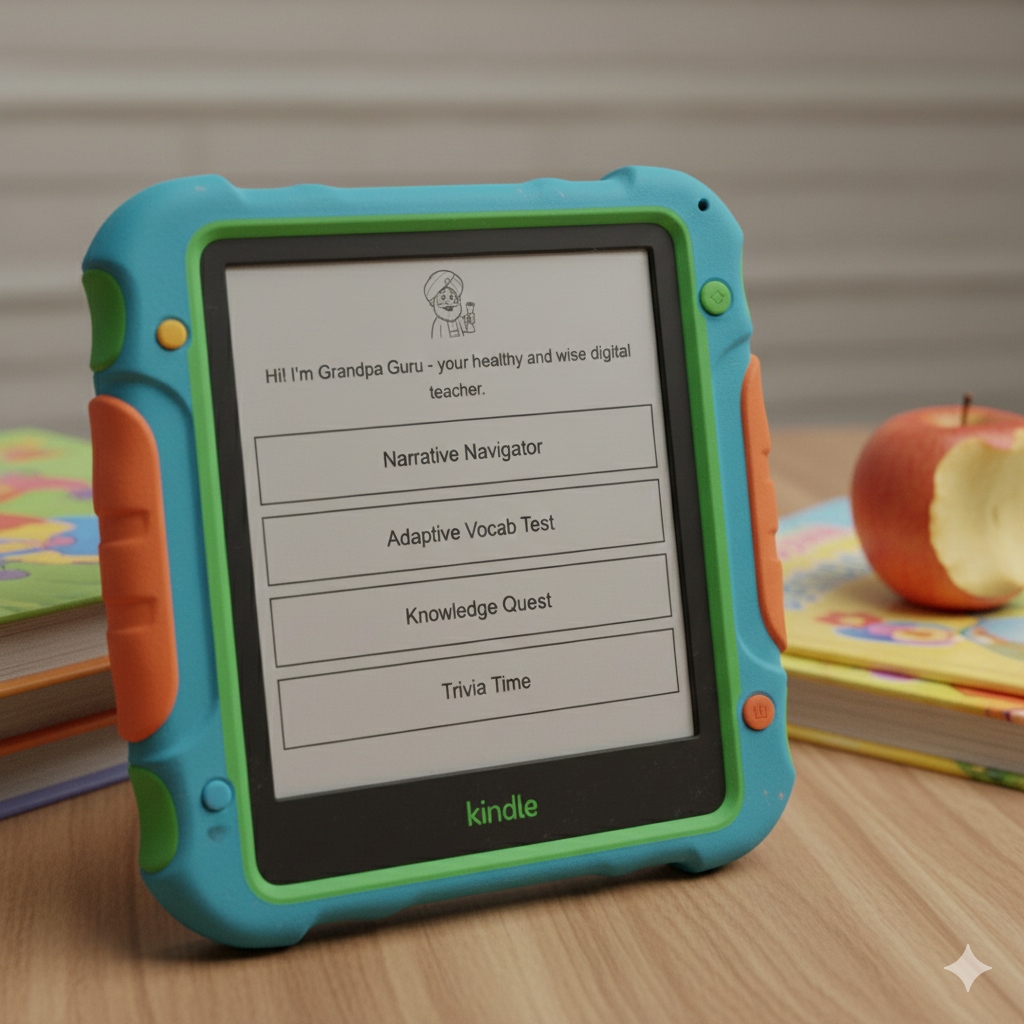
Screen Time, Redefined
We face a crisis of attention. Children are glued to dopamine-loop screens that overstimulate. "GG" (named after the gaming term "Good Game", but also hinting at "Good Gadget") was my attempt to build a device that fosters active rather than passive engagement.
The device is a simple, rugged E-ink tablet with a camera and a microphone. No browser. No social media. Just a window to curiosity.
PART II: USER EXPERIENCEMultimodal Interaction
The core interaction loop is physical:
- See: The child points the camera at a leaf.
- Ask: They press a button and ask, "What kind of leaf is this and why is it red?"
- Learn: The device sends the image and audio to the cloud. A multimodal model (GPT-4o) identifies the leaf (e.g., a Maple leaf in autumn), explains the color change using anthocyanins (simplified for a child), and displays the answer on the paper-like screen.
Cloud-Native Hardware
The hardware is "thin." It barely does any processing. It captures media and wakes up the radio.
The "brain" lives in Google Cloud Run. This serverless approach allowed the device to have incredible battery life (weeks on E-ink) because it only fully wakes up for seconds to transmit data. The backend orchestrates the STT (Speech-to-Text), the Vision analysis, and the TTS generation (optional).
"Technology should amplify our connection to the physical world, not replace it."
Why E-Ink?
E-ink is slow. That's a feature, not a bug. It forces a slower pace of interaction. It reduces eye strain. And crucially, it doesn't emit the blue light that disrupts circadian rhythms.